Full-Day or Extended-Hour Bilingual Program
As a Bilingual School, San Isidro College aims to achieve its educational goals in two languages. For this reason, English will be taught intensively through multiple activities and content.
Our Bilingual Project develops and builds from the earliest years of life, with a strong emphasis on correct pronunciation.
From a very young age, our children come into contact with their second language, responding to their communication and interaction needs. In this way, they learn to study, carry out activities, and “live” in English, graduating with knowledge and familiarity in the language that allows them to integrate comfortably into different English-speaking academic and work environments.
For this, the integrated curriculum plan in English and Spanish includes the corresponding International Certifications.
We work to facilitate and ensure the construction of a solid bond with the second language and foster confidence in students regarding their ability to learn it.
Through an intensive reading and oral production program, children naturally incorporate English in their daily lives, similar to the process of acquiring their mother tongue, using content that responds to their interests and needs.
Learning English from an early age allows them to easily acquire sounds, rhythms, and intonation. This way, we train their ear, achieving proper phonetics, ensuring comprehension, and initiating oral expression in a fun and natural way.
English: Indispensable
In a globalized world, learning a second language is an ever-growing necessity.
According to UNESCO documentation, in numerous international experiences, it is shown that teaching two or more languages reinforces other learning, especially the mother tongue (in both formative and instrumental aspects), and represents significant linguistic, cognitive, and socio-cultural benefits for students.
On the socio-cultural level, the benefit lies in the fact that knowing other languages allows people not only to expand their scope of action by communicating with members of other cultures but also to understand and value different customs and worldviews, thereby living with diversity.
Regarding how to access learning other languages, research shows that students’ learning is more meaningful and therefore longer-lasting when the language is used as a vehicle for learning other content and not only as an object of study in itself. Hence our Bilingual Educational Project proposal. Thus, bridges are built between the teaching of English and the rest of the curriculum areas: linguistic content is taught, and simultaneously, disciplinary content is approached.
Kindergarten
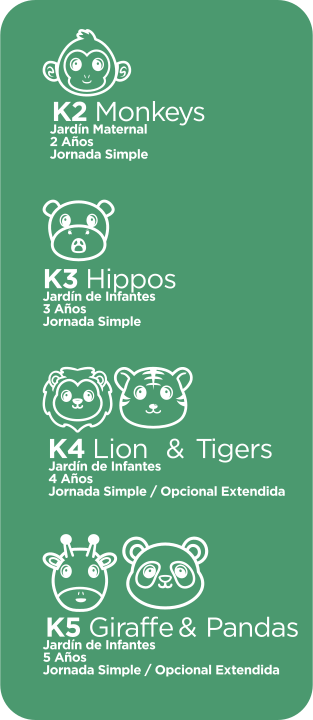
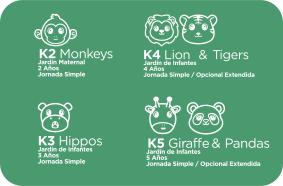
Our Bilingual Project starts in the nursery, K2, so that children are exposed to both languages throughout the day. The process continues in K3, K4, and K5.
One of our objectives at this stage is to strengthen the mother tongue and work on the early acquisition of English as a second language, promoting familiarization with it through daily situations inside and outside the classroom, coordinating articulation with the primary level so that the transition to the next stage of education is natural and safe.
Every day, we work with songs, dramatizations, puppets, stories, phrases, prompts, rhymes, intensified according to the group, until reaching full bilingualism at extended hours from age 5, where we work intensively with the English language to prepare them in the necessary language skills.
They can create, imagine, explore, and develop fantasy, observe their environment, develop their creative and artistic capacity, and acquire tools that foster oral and written language practices, problem-solving, and attitudes linked to empathy and respect for others.
The Importance of Play in Early Childhood
Play, in all its forms, as content and work strategy
From the age of two, activities are based on play, the main source of learning for children. Play, spontaneous and natural in this stage, is the fundamental axis. It allows us to approach their interests, needs, and thought processes.
For them, learning through play is natural, so its value as a learning tool is indisputable.
Some benefits of play in children include its contribution to psychomotor, cognitive, social, and affective-moral development. Through play, they gain experiences about themselves and the world around them, rehearse adult roles and behaviors, train skills, practice routines and sequences of behavior that will be useful throughout their lives. They test their knowledge, learn the relevance of playing in groups, and learn to tolerate others’ viewpoints. Additionally, it helps strengthen affective bonds. The foundation and engine of all deep learning is this bond, which allows creating and strengthening trust.
Primary
Our methodology is based on literature.
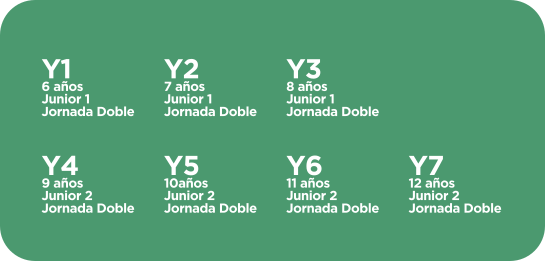
Mandatory subjects are carried out for all educational institutions (Jurisdictional Curriculum Design) and in English Areas: Language (Comprehension, Oral Language, Reading, Written Language, Creative Writing, Spelling), Drama, and Physical Education. Then the study plan adds: Literature, Social Studies, and Science.
In this level, it is important to promote the development of an attitude of effort, work, and responsibility in study and curiosity and interest in learning, strengthening confidence in one’s ability to learn.
Through play and varied activities appropriate to different ages, all aspects related to development and child evolution during the early years are covered. Special emphasis is placed on psychomotor, emotional, and intellectual development, stimulating curiosity, free thinking, moral awareness, and aesthetic enjoyment. We seek meaningful learning.
With a Bilingual Proposal, we work so that children can discover their talents and abilities. As a school prepared and advised by experienced professionals, we guarantee a natural incorporation of the English language as a second language. Thus, each student achieves broad language comprehension and expressive and communication skills.
Secondary
Leaders of the future
We prioritize a student-centered approach to develop key 21st-century skills such as autonomy, critical thinking, and creativity. With a solid bilingual foundation, we prepare our students for international exams and advanced technical English proficiency, tailored to their fields of study. We provide a space where learning comes to life.
We integrate Cambridge standards, ensuring international quality education. We offer exchanges and study trips that enrich their training and broaden their world view, preparing them for future challenges.
Dual Diploma
Our students independently pursue the dual United States High School Diploma. This option gives them a competitive edge, allowing them to obtain both an Argentine and a U.S. high school diploma simultaneously, expanding their academic and professional opportunities internationally.
We are Community
Academic Proposal: Excellence and International Dual Diploma
During the five years of Secondary School, we provide a full-day bilingual comprehensive education, combining the official Argentine curriculum with global competitiveness standards through international programs.
Our proposal is diversified into two tracks:
Natural Sciences: we foster scientific research and environmental commitment, using our high-complexity laboratory to transform theory into real experimentation.
Informatics: focused on technological creation, where students move from being users to developers of digital solutions, AI, and original prototypes.
International Projection: Cambridge and High School Diploma
We understand that today's world has no borders. Therefore, we strengthen our graduates' profiles with globally valid certifications.
- IGCSE Program (University of Cambridge): our students are prepared under this prestigious international standard that ensures elite academic preparation and a global mindset.
- Academica Dual Diploma®: starting in 2nd year, we offer the possibility to pursue this international validation program. Through an online platform with native teachers, students simultaneously obtain the local high school diploma and the American High School Diploma.
This linguistic and technological immersion experience positions them with a unique competitive advantage to enter the best universities in the world.
Our Identity: The Life Project
At San Isidro College, we understand that Secondary School is the stage where potential transforms into identity. Our goal is for each student to graduate with a solid, conscious, and autonomous Life Project.
We support each young person in discovering their purpose through a proposal that balances technological innovation and human warmth.
Professional Support: School Guidance Team (EOE)
At San Isidro College, well-being is a daily practice sustained by our School Guidance Team. We have professionals specialized in Psychology and Psychopedagogy dedicated to supporting our students' trajectories.
- Emotional Support: a space for listening and containment in the face of the challenges of adolescence.
- Learning Optimization: psychopedagogical intervention to strengthen cognitive skills and study processes.
- Relationships and Coexistence: support in group dynamics to sustain a healthy, inclusive, and respectful school climate.
This team works in an integrated way with external teams, teachers, and families to guarantee the professional support needed throughout each young person's Life Project.
Club and Foundation
We also open an institutional space to integrate the work of the Club and the Foundation, strengthening comprehensive development, community participation, and links with social-impact actions.